







Nvidia Partners with Groq to Strengthen AI Chip Dominance
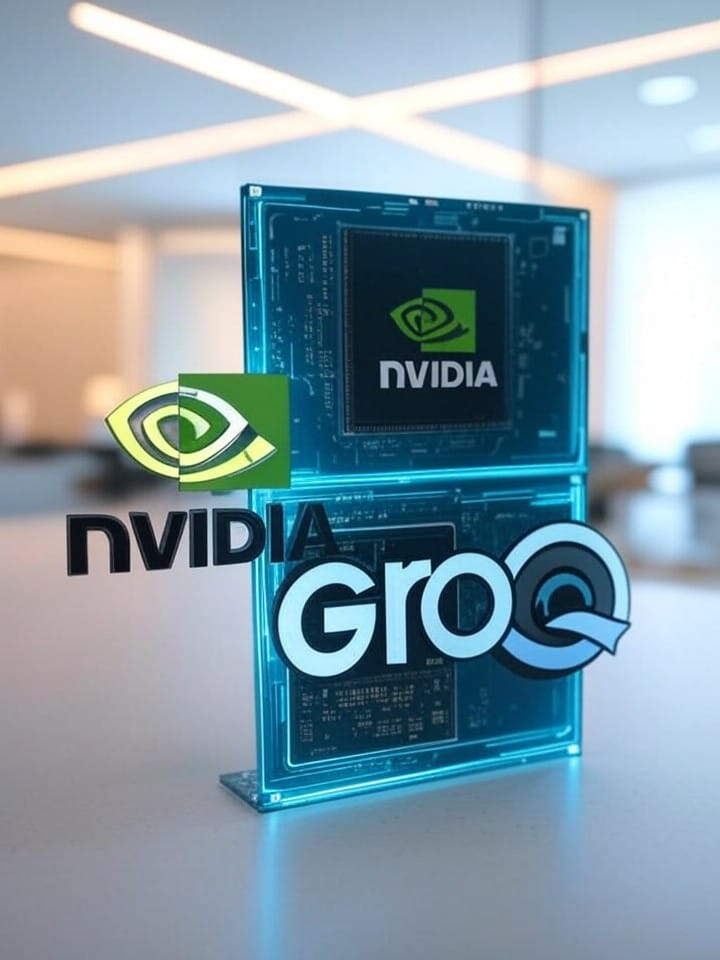
Nvidia, the global leader in artificial intelligence (AI) hardware and semiconductor design, has taken a bold step by partnering with Groq, a rising star in the AI chip industry. The collaboration involves Nvidia licensing Groq’s innovative processing technology and hiring the startup’s CEO to accelerate its next phase of growth and innovation. This move positions Nvidia to further solidify its dominance in high-performance computing and artificial intelligence chip manufacturing, an area already accounting for a major share of global data center growth.
The Strategic Partnership Between Nvidia and Groq
The announcement marks one of the most significant developments in the AI chip landscape in recent years. Nvidia will not only license Groq’s technology, which focuses on ultra-efficient AI inference processing, but also integrate key members of Groq’s leadership team. This strategic move emphasizes Nvidia’s intent to maintain its technological advantage amid increasing competition from AMD, Intel, and a growing wave of custom AI chip startups.
Groq has built a reputation for creating innovative chips that deliver exceptional performance per watt, making them ideal for applications that require high-speed, low-latency data processing. By leveraging Groq’s architecture, Nvidia aims to enhance its existing product lineup, particularly in inference and edge-computing scenarios where efficiency and responsiveness are critical.
Why Nvidia’s Acquisition of Talent Matters
The decision to bring Groq’s CEO into Nvidia’s executive ranks demonstrates the company’s continued commitment to attracting top-tier talent from emerging technology firms. In the highly competitive semiconductor industry, leadership grounded in deep technical expertise is as valuable as the hardware itself. Groq’s CEO has been instrumental in pioneering a new class of processors capable of executing complex AI tasks with minimal energy consumption—an area Nvidia has increasingly prioritized as AI workloads scale dramatically.
By combining this talent with Nvidia’s vast resources and developer ecosystem, the company is poised to accelerate innovation in AI infrastructure and next-generation chip design. The collaboration also hints at Nvidia’s growing focus on sustainable AI computing, a crucial theme as global demand for data processing continues to rise.
Understanding Groq’s AI Chip Technology
Groq’s technology centers around a unique architecture known as the Tensor Streaming Processor (TSP). Unlike traditional GPUs, which rely on parallel cores to execute instructions, the TSP design leverages deterministic data flow, reducing latency and maximizing predictability. This makes Groq’s chips particularly well-suited for AI inference workloads such as language processing, recommendation systems, and autonomous systems.
By incorporating this architecture into Nvidia’s broader product portfolio, the company could reduce bottlenecks in AI model deployment while offering developers new levels of performance efficiency. This approach contrasts with Nvidia’s established GPU framework, suggesting that the integration could lead to hybrid solutions optimized for different AI workloads.
Innovation Meets Market Demand
As AI adoption accelerates across industries—from autonomous vehicles and robotics to medical imaging and financial modeling—demand for faster and more efficient chips continues to surge. Nvidia already dominates the AI training market, but inference, which typically occurs after AI models are trained, represents a massive growth opportunity. With Groq’s energy-efficient architecture, Nvidia can extend its reach into this lucrative sector and provide customers with complete end-to-end AI solutions.
This move also reflects Nvidia’s strategic push to diversify its technological base. By not relying solely on GPU architectures, the company safeguards itself against potential supply chain disruptions and maintains competitive agility in a rapidly changing semiconductor landscape.
Market Reactions and Competitive Landscape
Following the announcement, market analysts have pointed to the strategic importance of this move in reinforcing Nvidia’s leadership position. While companies like AMD and Intel continue to introduce new AI-focused chips, Nvidia’s acquisition of Groq technology underscores its willingness to innovate beyond its traditional GPU core. Industry experts believe this combination of proven hardware and novel AI processing design could reshape how AI applications are developed and deployed globally.
Furthermore, Nvidia’s partnership with Groq arrives as governments and enterprises worldwide increase investment in AI infrastructure. The move could have far-reaching implications for cloud computing providers, AI developers, and edge device manufacturers seeking greater efficiency and scalability in their workloads.
Competitors React to Nvidia-Groq Collaboration
For competitors, Nvidia’s latest move raises the stakes. AMD’s latest generation of AI accelerators and Intel’s Gaudi family of processors target AI-related computing tasks, but Nvidia’s aggressive adoption of innovative external technology highlights its commitment to staying ahead. Deep partnerships like this not only strengthen Nvidia’s product portfolio but also enable faster time-to-market for new solutions.
Startups focused on niche AI hardware may also view Nvidia’s strategy as validation of alternative architectures beyond GPUs. The integration of Groq’s deterministic chip technology signals to the industry that diverse approaches to AI computation are being recognized and rewarded by market leaders.
Implications for AI Development and Data Centers
The ramifications of this partnership extend beyond chip manufacturing. Nvidia’s dominance in data center architecture and AI cloud infrastructure means that Groq’s architecture could soon underpin AI workloads at scale. Data centers powered by an Nvidia-Groq hybrid approach may offer unprecedented speed and efficiency for applications such as generative AI, natural language processing, and advanced automation.
Additionally, as AI models grow larger and more computationally demanding, there is a pressing need for chips capable of running inference tasks efficiently without consuming excessive power. Groq’s lightweight, deterministic design offers a practical solution to these challenges, reinforcing Nvidia’s leadership across the entire AI workflow—from training to deployment.
Advancing Sustainable AI Computing
Sustainability has become an increasingly important theme in AI development. Data centers consume vast amounts of energy, and optimizing hardware performance per watt is critical for reducing carbon footprints. Nvidia’s partnership with Groq directly addresses this issue by integrating more energy-efficient processor designs. This move not only benefits enterprise clients but also positions Nvidia as an industry leader in promoting responsible AI innovation.
What This Means for Nvidia’s Future
By licensing Groq’s technology and hiring its CEO, Nvidia demonstrates a clear long-term vision. The company’s ability to recognize promising technology and integrate external innovation reflects a growth strategy centered on adaptability and continuous improvement. This collaboration will likely accelerate Nvidia’s roadmap for specialized AI processors, potentially setting the stage for new categories of hybrid computing devices.
Nvidia’s move also highlights a broader trend within the tech industry: the convergence of hardware and software ecosystems around AI optimization. With Groq’s deterministic approach complementing Nvidia’s parallel GPU architecture, the resulting synergy could redefine performance benchmarks in AI computation for years to come.
Conclusion: A Defining Move for the AI Chip Industry
Nvidia’s partnership with Groq marks a defining moment in the evolution of AI chip technology. By combining Groq’s pioneering design with Nvidia’s vast expertise and resources, the alliance represents a leap forward for AI hardware innovation. As Nvidia continues to push the boundaries of chip performance, efficiency, and scalability, this strategic collaboration sets a new industry standard for how major players can harness emerging technologies to maintain leadership in an increasingly competitive landscape.
For developers, enterprises, and researchers worldwide, the fusion of Nvidia’s and Groq’s capabilities promises faster, more sustainable, and more efficient AI computing—from the data center to the edge. As the future of artificial intelligence unfolds, Nvidia’s latest move signals a powerful message: leadership in AI is built not just on innovation, but on the ability to integrate and amplify the world’s best ideas.