








OpenAI Empowers ChatGPT Users with Adjustable Enthusiasm Settings
OpenAI has taken another step toward personalization by allowing users to directly adjust ChatGPT’s enthusiasm level. This new capability gives users more granular control over how the AI communicates, whether they prefer a more energetic tone or a calm, professional demeanor. By integrating this setting, OpenAI continues to refine user experience with its flagship conversational model, making it more flexible for diverse applications across industries and contexts.
What the Enthusiasm Adjustment Feature Means for Users
The newly introduced enthusiasm setting allows users to shape how ChatGPT expresses itself. Previously, ChatGPT’s tone was mostly determined by the underlying model and user prompts. With this update, users no longer need to craft complex instructions to receive a certain tone. Instead, they can tweak the AI’s enthusiasm directly through interface controls or custom parameters. For instance, a teacher designing study materials might prefer a lively and encouraging tone, while a business professional drafting emails may prefer concise and measured responses.
This feature effectively bridges the gap between prompt engineering and user experience, giving users the ability to make dynamic adjustments without extensive technical knowledge. It also supports OpenAI’s goal of making conversational AI more natural, adaptable, and human-centric.
How the Feature Works
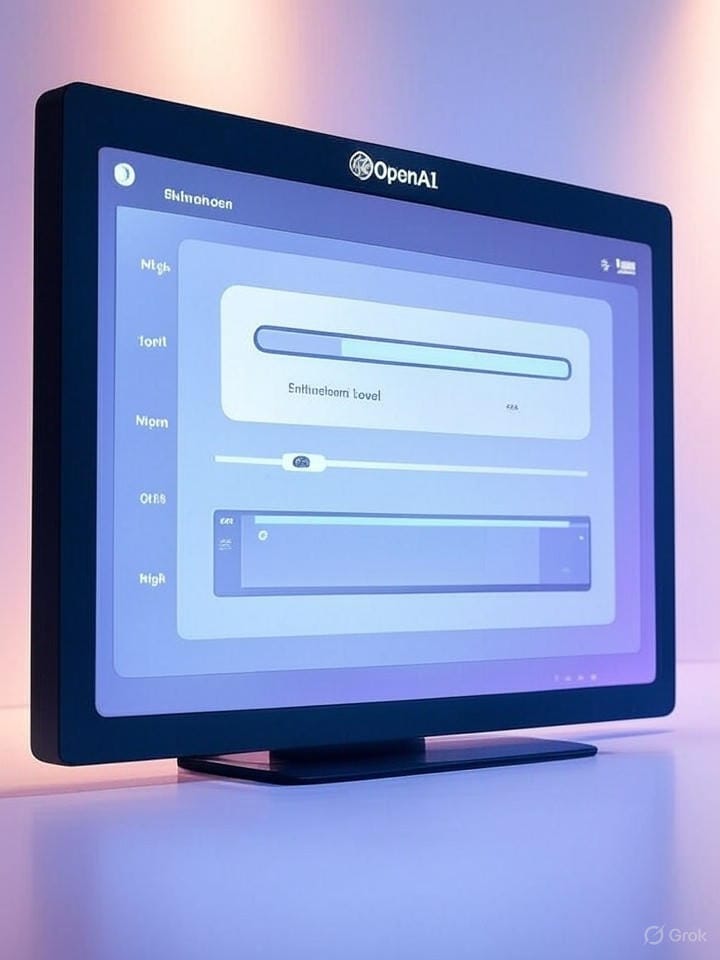
According to OpenAI’s product team, the enthusiasm adjustment is part of a broader effort to give users more stylistic control over ChatGPT’s personality traits. The interface includes a slider or simple selection menu that allows real-time modifications. Users can increase enthusiasm for more vibrant language or reduce it for formal interactions.
For developers using the API, enthusiasm parameters can be integrated directly into system prompts or user configurations. This means that businesses can automate different communication styles depending on context — for example, a customer support chatbot using an upbeat tone for new customers but a more neutral tone for technical troubleshooting.
Why Personalization Matters in AI Communication
Personalization is a key driver in the advancement of artificial intelligence. As AI systems become central to communication workflows, users expect responses that feel authentic, empathetic, and appropriate for their situation. The ability to control enthusiasm enhances accessibility across audiences, ensuring that outputs match emotional tone as well as informational needs.
OpenAI’s introduction of customizable tone aligns with a wider trend among AI providers. Major platforms are increasingly enabling users to define stylistic parameters, such as Empathy, Formality, or Humor. Enthusiasm is another critical layer that influences perceived intent and engagement. By letting users control this emotional vector, OpenAI has made ChatGPT more relevant for branding, education, mental health support, and customer relations.
Real-World Use Cases
- Customer Service: Businesses can fine-tune enthusiasm to convey positivity without sounding insincere, helping build trust and improve satisfaction.
- Education: Teachers can increase enthusiasm to make learning material more engaging for students, or tone it down for academic writing and feedback.
- Marketing: Marketers can set ChatGPT to maintain a vibrant tone suitable for promotional content or social media engagement.
- Healthcare Support: In medical contexts, a calm and reassuring tone can be achieved by lowering enthusiasm levels, ensuring sensitivity in communication.
These examples highlight the growing role of tonal control in making AI interactions both effective and emotionally intelligent.
Industry Implications and Competitive Landscape
OpenAI’s addition of enthusiasm control also signals intensifying competition in the AI assistant market. Companies like Anthropic, Google DeepMind, and Meta are likewise focusing on controllable generation features. By expanding ChatGPT’s customization options, OpenAI secures a stronger foothold among enterprise users seeking adaptive AI tools that align with brand voice and communication strategy.
One noteworthy aspect of OpenAI’s strategy is its emphasis on user accessibility. While developers can already fine-tune models, this feature democratizes control at the user level. Even those without programming expertise can now adjust the AI’s output with a simple interface, similar to adjusting volume or brightness settings on a device.
Graphite and the Growing Ecosystem of AI Tools
In the larger AI landscape, OpenAI’s updates coincide with growing innovation from related platforms. For example, Graphite, an AI-driven code review assistant, recently reached a valuation of $290 million. Tools like Graphite focus on deep automation in niche domains, complementing the more generalized conversational intelligence of ChatGPT. The coexistence of these tools underscores how AI innovation is diversifying — some systems are becoming highly specialized, while others, like ChatGPT, are evolving to serve broader and more customizable roles.
This cross-section of developments suggests a future where AIs can seamlessly integrate with one another. ChatGPT’s tone control could, for instance, enhance human-AI collaboration when paired with code review assistants like Graphite, giving developers feedback that’s not only technically sound but also appropriately engaging.
User Experience and Feedback
Early reactions from users suggest that the enthusiasm adjustment feature adds meaningful value to ChatGPT’s usability. Many note that it improves the AI’s ability to fit into diverse workflows. Users can now maintain brand consistency or emotional tone without extensive editing or model switching. In addition, beta testers have praised how the feature enhances productivity, enabling smoother prompt iteration and content refinement.
OpenAI continues to collect feedback to optimize the feature’s responsiveness and ensure that adjustments produce consistent outcomes. The company also aims to expand tone customization in future updates, potentially adding parameters like politeness, humor, or empathy to create a more comprehensive personalization dashboard.
What Comes Next for OpenAI
This enthusiasm control is merely the latest in a series of incremental improvements to ChatGPT. OpenAI’s recent model updates have included more context retention, multimodal capabilities, and memory features that allow persistent personalization across sessions. The company’s roadmap clearly points toward evolving ChatGPT from a reactive chatbot into a fully adaptive digital companion.
Over time, users may gain access to even deeper personalization layers, allowing control over voice inflection, pacing, and emotion across text and voice interactions. This could redefine how professionals, educators, and creators use AI tools in their daily lives.
Conclusion
OpenAI’s decision to let users adjust ChatGPT’s enthusiasm level marks a thoughtful progression in conversational AI design. By combining technical precision with emotional flexibility, the company continues to enhance user engagement and context adaptability. This innovation reaffirms OpenAI’s commitment to aligning its technology with human creativity and communication needs.
As more tools like Graphite push boundaries in specialized AI development, OpenAI’s focus on humanizing interaction ensures ChatGPT remains at the forefront of user-centered artificial intelligence. Ultimately, giving people control over how their AI sounds is not just about tone — it’s about trust, authenticity, and creating richer human-AI collaboration experiences.